What Are Blue Light Emergency Towers at Hospitals?
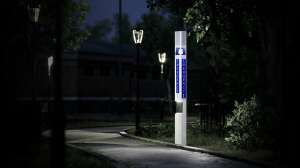
An illuminated emergency call station stands along a campus walkway, offering direct access to help at the push of a button — a visible, always-on layer of physical security after dark.
Walk through almost any hospital parking garage or dimly lit staff lot after dark and you’ll likely spot a tall, illuminated column topped with a flashing blue beacon. These are blue light emergency towers, and for hospitals, they’ve become one of the simplest, most visible ways to give patients, staff, and visitors a direct line to help when every second counts. Also known as hospital emergency call boxes or blue light phone towers, they’re a small piece of equipment with an outsized role in hospital campus safety. If you’ve ever wondered what these towers actually do, how they work, and why so many healthcare campuses are installing them, here’s a full rundown.
What Are Blue Light Emergency Towers?
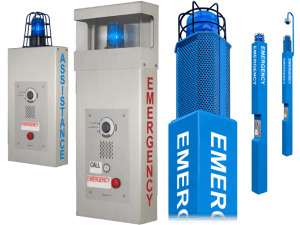
A full range of emergency communication stations — from wall-mounted ADA call boxes to freestanding blue light towers and slim call poles — built for campus, parking, and public safety applications.
Blue light emergency towers are standalone communication stations placed in parking lots, garages, walkways, and other outdoor areas around a hospital campus. Each tower is topped with a bright, flashing blue light that makes it easy to spot from a distance, even at night or in bad weather. Press the button, and you’re connected instantly, through two-way audio, to hospital security, a dispatch center, or local emergency responders.
There’s no need to dial a number, unlock a phone, or remember an extension. That immediacy is exactly the point: blue light emergency towers exist to remove every possible barrier between someone in distress and the help they need.
How Blue Light Emergency Towers Work
Most blue light emergency towers operate on a simple principle: one button, one connection, no delay. A person presses a clearly marked button, and the unit opens a full-duplex audio channel to a monitored security or dispatch console. Many units also trigger the blue beacon to strobe once a call is placed, which helps responding staff locate the caller quickly across a large lot or structure. Higher-end blue light emergency towers add extras like built-in CCTV cameras, public address speakers for campus-wide announcements, and self-diagnostic technology that flags a malfunctioning unit before it’s ever needed in a real emergency. Some facilities pair a network of these emergency call stations with interior panic buttons so the same dispatch console covers both indoor and outdoor incidents. Because these towers are hardwired or connected via cellular or IP networks, they keep working even in areas where a personal cell signal is weak, which is common in parking structures built from steel and concrete.
Why Hospitals Rely on Blue Light Emergency Towers
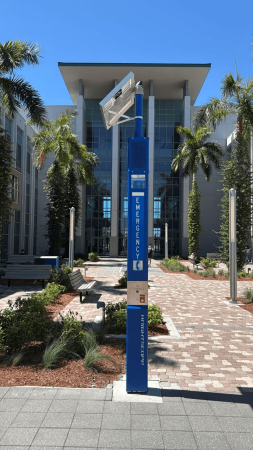
A solar-powered Knightscope emergency call station stands ready in a campus courtyard, giving students and staff instant access to security with the push of a button.
Hospitals run around the clock, which means staff are walking to their cars at 2 a.m., visitors are leaving after difficult news, and patients are being discharged at every hour of the day and night. Parking lots and garages are consistently flagged as higher-risk areas on any healthcare campus, simply because they’re less populated and further from the building’s main entrances.
Blue light emergency towers address that gap directly. A nurse finishing a night shift, a visitor unfamiliar with the layout, or a patient waiting for a ride can reach real help in seconds, without searching for a phone or a badge-swipe door. Beyond direct emergencies, the towers also function as a visible deterrent. Their presence alone tends to discourage the kind of opportunistic incidents that are more likely in poorly monitored outdoor spaces, which is a meaningful benefit for any hospital security and risk management team focused on hospital campus safety.
Key Features to Look For
Not every blue light emergency tower is built the same way, and hospitals evaluating vendors should look for a few specific features:
- ADA-compliant design, including push-button activation at wheelchair-accessible height
- Two-way, full-duplex audio so callers and responders can speak and hear simultaneously
- Weather- and vandal-resistant construction built to survive years of outdoor exposure
- Integrated cameras or PA capability for added situational awareness and mass notification
- Self-monitoring diagnostics that alert facilities teams to maintenance issues automatically
These features matter because a blue light emergency tower is only useful if it works flawlessly the one time it’s truly needed.
Blue Light Towers vs. Other Hospital Safety Measures
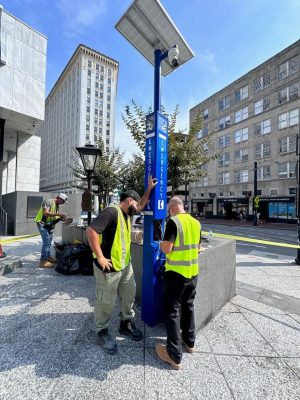
Technicians wire a solar-powered emergency call box and security camera into place — the same low-voltage backbone of power, data cabling, and grounding that keeps roadside camera systems like Philadelphia’s speed enforcement network running.
Blue light emergency towers aren’t meant to replace a hospital’s broader security plan, they’re meant to complement it. Security patrols, badge access, interior cameras, and staff escort programs all play a role, but none of them offer the same combination of visibility and instant connection that a blue light emergency tower provides in an open outdoor space. A security guard can’t be everywhere at once, and a badge reader doesn’t help someone who’s already outside in a parking lot. Blue light emergency towers fill that specific, high-risk gap, acting as a constant, always-on layer of protection that doesn’t rely on staffing levels or time of day.
For hospitals, safety isn’t limited to what happens inside the building. Parking lots, garages, and outdoor walkways are part of the patient and staff experience too, and they deserve the same level of protection. Blue light emergency towers offer a proven, highly visible way to close that gap, giving everyone on campus a fast, reliable way to call for help the moment they need it. As healthcare campuses continue to expand their outdoor footprints, blue light emergency towers are quickly becoming a standard, not just an upgrade, in hospital safety planning.
For help with any project or installation in the New Jersey or Philadelphia area please call us at 877-832-1206.
For more ideas please visit – https://www.bridgecable.com/services/
For more information and educational content please visit:
https://www.youtube.com/@BridgeCable
Copyright © 2026 Bridge Cable. All rights reserved.
Mailing: 2745 Terwood Road, Willow Grove, PA 19090
Warehouse: 2066 W. Hunting Park Ave, STE 308, Philadelphia, PA 19140
Recent Posts
Why Your Inventory Heatmap Must Match Peak Stock
Wi-Fi 7 Business Connectivity in Pennsylvania