Why Does Access Control During a Power Outage Matter?
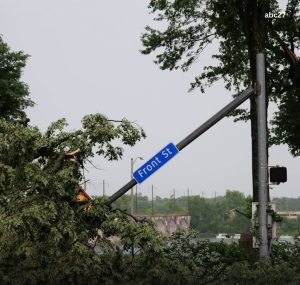
Storm winds snapped a large tree limb and bent a traffic signal pole along Front Street, leaving debris tangled across the roadway.
Storms roll through, a transformer blows, or the grid just hiccups — and suddenly every door in your building is a question mark. Will it lock? Will it unlock? Will people be trapped, or will your building be wide open to anyone who walks up? This is the moment when access control during a power outage stops being a line item on a spec sheet and becomes the difference between a minor inconvenience and a genuine safety and security failure.
Most facility managers only think about their door hardware when something goes wrong. But the brands and products you choose long before the lights flicker are exactly what determine how your building behaves the instant they do. Cheap, mismatched, or poorly rated components can fail silently — and you won’t find out until the power is already gone. Planning for access control during a power outage now, rather than after an incident, is what separates buildings that stay secure from buildings that get caught off guard.
What Happens to Doors When the Power Goes Out?
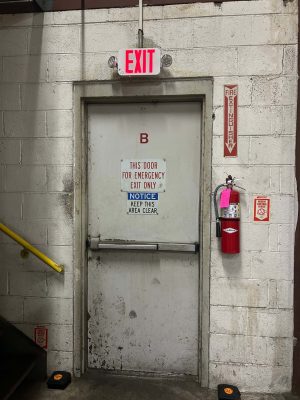
A commercial exit door fitted with mechanical panic hardware — the type of crash bar that mullion-mounted REX devices are built into, mechanically signaling the access control panel the instant someone pushes through to leave.
Every electrified opening — magnetic locks, electric strikes, electrified exit devices, motorized locksets — depends on power to do its job one way or another. When that power disappears, the hardware has to default to a predictable, code-compliant state. That’s where access control during a power outage becomes a design decision, not an accident. A well-engineered system tells every door exactly what to do the instant it loses power, whether that means releasing for safe egress or holding firm to keep a secured area protected.
The problem is that not every product on the market handles this transition cleanly. Lower-quality controllers can lock up in an unpredictable state, drop communication with the panel, or fail to release properly for fire and life-safety egress. That’s a liability issue as much as it is a convenience one, and it’s exactly why manufacturers who test rigorously for access control during a power outage are worth the extra research before you buy.
Fail-Safe vs. Fail-Secure: Which Locks Protect You When the Power Goes Out?
This is where fail-safe vs. fail-secure locks become essential vocabulary for anyone specifying hardware. A fail-safe lock unlocks automatically when power is lost, which is required on most egress routes so people can exit freely during an emergency. A fail-secure lock does the opposite — it stays locked when power drops, which is often used on doors protecting servers, cash, pharmaceuticals, or other high-value assets where unauthorized access is the bigger risk.
Choosing the correct configuration for each opening — and pairing it with hardware from a manufacturer that actually rates and tests for these conditions — is one of the clearest examples of why access control during a power outage deserves real planning rather than an afterthought. Get it backwards on even one door, and you either trap people inside or leave a sensitive area exposed.
Battery Backup and Power Supplies: The Unsung Heroes
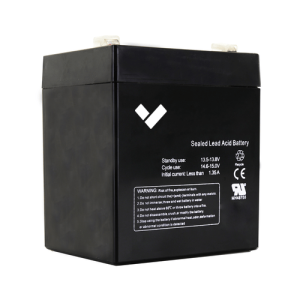
Our 12V 4Ah sealed lead acid battery delivers dependable backup power for alarms, access control panels, and emergency lighting systems.
A great lock is only as good as what’s feeding it power in the first place. Reliable battery backup access control systems bridge the gap between “the grid is down” and “the generator kicks in” — or cover you entirely if there’s no generator at all. Quality power supplies with properly sized batteries can keep card readers, controllers, and locking hardware running for hours, buying time for staff to respond and for systems to shut down gracefully instead of just cutting out.
This is one of the areas where brand quality matters most. Premium power supply manufacturers build in battery monitoring, low-voltage alerts, and clean failover, while bargain units often just stop working the moment mains power drops — no warning, no graceful transition, nothing. When you’re evaluating power outage security systems, the power supply deserves just as much scrutiny as the lock on the door, because reliable access control during a power outage starts at the power supply, not the lock itself.
Choosing Reliable Access Control Brands
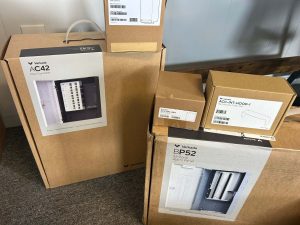
Fresh off the truck: the Verkada AC42 door controller, BP52 32-zone alarm panel, backup battery, and rain hood — the core hardware for this access control install.
Not all manufacturers engineer for the worst-case scenario. Established brands in the access control space — the ones that dominate commercial and institutional installs — invest heavily in UL-listed components, documented fail-safe/fail-secure behavior, and backup power compatibility precisely because they know access control during a power outage is when their reputation is actually tested. Off-brand or unrated hardware might save money upfront, but it’s rarely built with the same rigor around power-loss behavior, and that gap only shows up at the worst possible time.
When you’re comparing products, look past the price tag and ask: How does this hardware behave in a total power loss? Is battery backup supported out of the box? Is the fail-safe/fail-secure setting field-configurable? Does the manufacturer publish real testing data? Those answers matter far more than a glossy spec sheet, and they’re the fastest way to tell which brands actually take access control during a power outage seriously.
Compliance and Emergency Lockdown Readiness
Life-safety codes don’t pause for a blackout. Fire and building codes require that egress doors remain operable during emergency lockdown power failure scenarios, and inspectors will absolutely check this. Beyond code compliance, a thoughtful outage plan should also address how lockdown procedures function without power — because a security event during a storm is exactly when a building can’t afford confusion at the door.
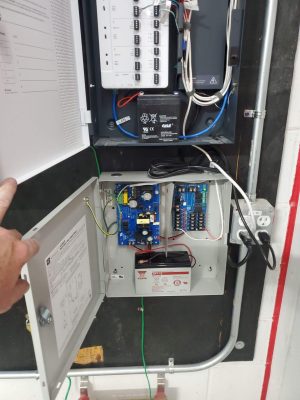
Inside a hybrid access control installation: the local door controller (top) handles real-time lock and credential decisions on-site, while a dedicated Altronix power supply and battery backup (bottom) keep doors operating through a power interruption — the on-premise foundation that a cloud dashboard layers on top of.
Facilities that plan for this pair code-compliant fail-safe egress hardware with fail-secure protection on sensitive areas, backed by battery power that’s sized for real-world outage durations, not just a quick five-minute bridge. That combination is the practical definition of getting access control during a power outage right — safe, compliant, and secure at the same time.
A power outage will happen eventually — it’s not a matter of if, but when. The manufacturers and products you choose today decide whether that moment is a non-event or a full-blown incident. Investing in trusted brands, properly configured fail-safe and fail-secure hardware, and dependable battery backup isn’t overengineering — it’s exactly what makes access control during a power outage work the way it’s supposed to, every single time the lights go out.
For help with any project or installation in the New Jersey or Philadelphia area please call us at 877-832-1206.
For more ideas please visit – https://www.bridgecable.com/services/
For more information and educational content please visit:
https://www.youtube.com/@BridgeCable
Copyright © 2026 Bridge Cable. All rights reserved.
Mailing: 2745 Terwood Road, Willow Grove, PA 19090
Warehouse: 2066 W. Hunting Park Ave, STE 308, Philadelphia, PA 19140
Related Posts
Smart Crates for Animals and Bridge Cable
How Different Biometric Devices Improve Modern Access Control Systems