What’s New in Hotel Keyless Entry Technology?
Guests used to fumble with a heavy brass key and a wall-mounted rack behind the front desk. Today, that ritual is disappearing fast. Hotel keyless entry has moved from a novelty at boutique properties to a standard expectation across nearly every tier of hospitality, and the technology behind it keeps getting smarter, faster, and more secure.
What Is a Hotel Keyless Entry?
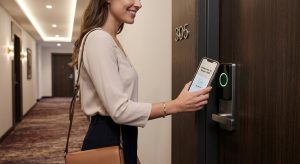
With hotel keyless entry, guests skip the front desk and unlock their room with a simple tap of their smartphone.
Hotel keyless entry replaces the traditional metal key or basic magstripe card with a digital credential — a mobile app, an encrypted key card, a biometric scan, or a wearable — that unlocks a guest room without a physical key ever changing hands.
The lock communicates with the property management system, so access can be granted, changed, or revoked instantly, and every entry attempt is logged for security purposes.
Key Advances Driving Hotel Keyless Entry Today
Mobile key technology. The biggest leap in hotel keyless entry has been the shift to smartphones as the credential itself. Guests check in remotely, receive a digital key through the hotel’s app, and unlock their door with a tap or a Bluetooth handshake — no stop at the front desk required. For hotels, mobile key technology also cuts the cost of replacing lost or demagnetized cards.
Biometric hotel security. A growing number of properties are piloting fingerprint and facial recognition locks, particularly at high-end resorts and extended-stay properties where guests return often. Biometric hotel security removes the credential entirely — there’s nothing to lose, share, or clone, though adoption is still limited by cost and guest comfort with the technology.
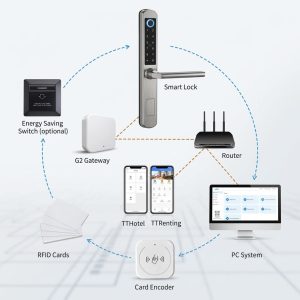
A typical hotel keyless entry setup: the cloud-connected smart lock communicates through a gateway and router to the front-desk PC system, while staff use a card encoder and the TTHotel/TTRenting apps to issue and manage guest access in real time.
Cloud-connected locks. Older RFID systems required staff to physically reprogram or reset locks at the door. Modern hotel keyless entry runs on cloud-connected hardware that syncs with the property management system in real time, so a late checkout, an early departure, or a room change updates access instantly across the entire property.
Contactless check-in integration. Hotel keyless entry now pairs tightly with contactless check-in kiosks and app-based arrival flows. A guest can book, verify identity, select a room, and receive their digital key before ever speaking to staff — a workflow that surged during the pandemic and has stayed popular for its convenience.
Improved battery and offline resilience. Early electronic locks were notorious for dead batteries locking guests out. Newer hotel keyless entry hardware includes low-battery alerts sent directly to housekeeping and engineering teams, plus offline fallback modes that keep locks functioning during a network outage.
Benefits Hotels Are Seeing
Security teams like hotel keyless entry because every unlock event is timestamped and attributable, which simplifies investigations and liability claims compared to a shared metal key. Guests like the convenience of skipping the front desk, and operations teams appreciate that lost cards or forgotten mobile keys can be deactivated remotely in seconds rather than requiring a full rekey. Energy management is a quieter win too — many hotel keyless entry systems integrate with in-room thermostats and lighting, so the room only draws full power when a valid key is present.
What to Weigh Before Upgrading

As hotels modernize what happens behind the door — from mobile keys to biometric locks — the classic vertical marquee still marks the entrance to a stay that increasingly starts before a guest ever reaches the front desk.
Guest demographics matter. A property serving mostly business travelers may see fast adoption of mobile key technology, while a resort catering to older or less tech-comfortable guests may need to keep traditional key cards available as a fallback within any hotel keyless entry rollout.
Integration with existing systems. Hotel keyless entry hardware needs to talk cleanly to the property management system, the booking engine, and often a loyalty app. A mismatch here creates more support tickets than it solves.
Cybersecurity. Because hotel keyless entry credentials travel over Bluetooth, Wi-Fi, or cellular networks, encryption standards and regular firmware updates matter as much as the physical lock hardware. A weak implementation can expose guest data or, worse, room access itself.
Staff training and fallback procedures. Front desk and housekeeping teams still need a manual override process for when hotel keyless entry systems glitch, a phone dies, or a guest simply prefers a physical card.
Expect hotel keyless entry to keep converging with the rest of the smart-room experience — voice-activated locks, wearable credentials, and even blockchain-secured digital keys are already in pilot programs at a handful of major chains. The properties that get ahead of this shift aren’t just chasing a trend; they’re building the kind of frictionless, secure arrival experience that guests increasingly expect as the default, not the upgrade.
For help with any project or installation in the New Jersey or Philadelphia area please call us at 877-832-1206.
For more ideas please visit – https://www.bridgecable.com/services/
For more information and educational content please visit:
https://www.youtube.com/@BridgeCable
Copyright © 2026 Bridge Cable. All rights reserved.
Mailing: 2745 Terwood Road, Willow Grove, PA 19090
Warehouse: 2066 W. Hunting Park Ave, STE 308, Philadelphia, PA 19140
Related Posts

What Is Hybrid Access Control and How Does It Work?
How Do You Choose the Right REX Devices?