Access Control & Structured Cabling for Healthcare Facilities
A hospital never closes. Three shift changes a day, traveling nurses on short contracts, rotating residents, vendor reps, patients, and families all move through the same building around the clock. Every door has to open instantly for the right person and stay shut for everyone else, often while someone is pushing a stretcher. That’s why access control system installation in healthcare looks different from any office project, and why it depends so heavily on structured cabling for healthcare facilities that keeps every reader, lock, and camera online 24/7.
Why Access Control Is Different in Healthcare

Exit doors like these must let people out quickly in an emergency, yet they’re also where vulnerable patients can wander out unnoticed. Healthcare access control has to balance free egress with protection, which starts with careful design and structured cabling for healthcare facilities that links exit doors to alarms and staff alerts.
Most commercial buildings protect people and property. Hospitals and clinics have to protect those plus controlled medications, newborns, behavioral health patients, protected health information (PHI), and the clinical systems that keep patients alive. A single facility may have public lobbies, semi-public waiting rooms, staff-only corridors, and high-security zones like the pharmacy, NICU, labor and delivery, sterile processing, and IT closets, all within a few hundred feet of each other. Every one of those zones relies on structured cabling for healthcare facilities to connect its readers, locks, and alarms.
The stakes run in both directions. A door that won’t open slows a code team. A door that opens too easily lets someone into a medication room or a maternity unit. Getting that balance right takes careful design, the right hardware, and structured cabling for healthcare facilities that is built for a building that never shuts down.
Types of Access Control Systems for Healthcare Facilities
Key card access systems. Badge readers remain the backbone of most hospitals. Older 125 kHz proximity cards are easy to clone, so many facilities are moving to encrypted smart cards. The same badge can often unlock doors and log clinicians into shared workstations with a tap.
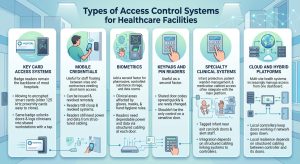
Six common access control options for hospitals and clinics, from key card access systems to cloud and hybrid platforms. Each one depends on structured cabling for healthcare facilities to deliver power and data to every reader, lock, and controller.
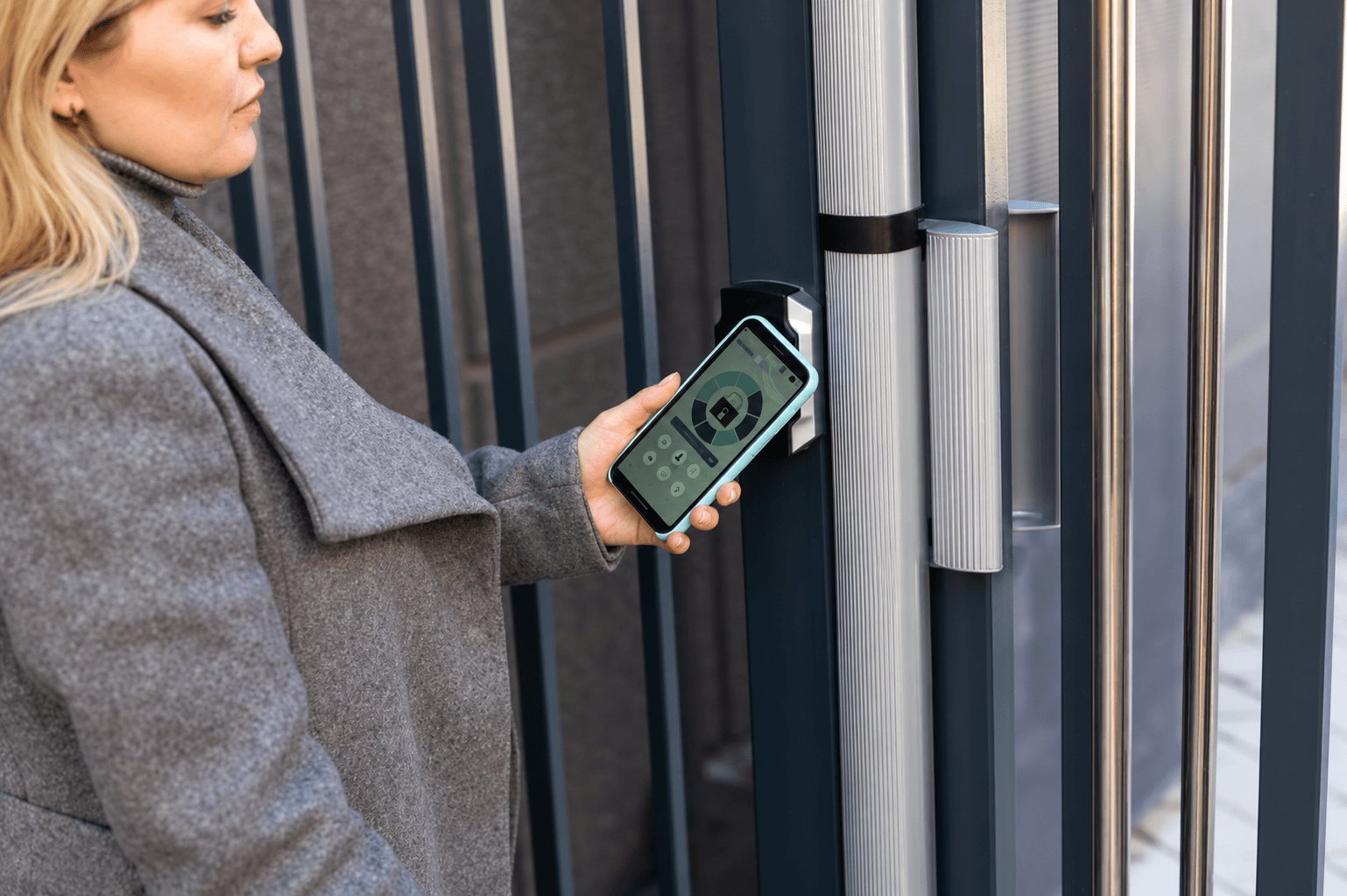
Mobile credentials. Phone-based credentials are useful for staff who float between sites and for contractors who need short-term access, since they can be issued and revoked remotely. Readers that accept them still need power and data from structured cabling for healthcare facilities.
Biometrics. Fingerprint, palm, and facial readers add a second factor for pharmacies, controlled-substance storage, and data rooms. In clinical areas, gloves, masks, and hand-hygiene rules affect which biometric types work in practice. Biometric readers also need dependable power and data, which structured cabling for healthcare facilities must plan for at each door.
Keypads and PIN readers. Useful as a second factor, but shared door codes spread quickly and are rarely changed, so they shouldn’t be the only control on a sensitive door.
Specialty clinical systems. Infant protection, patient wander-management, and medication cabinet access often integrate with the main platform, so a tagged infant near an exit can lock doors and alert staff at once, as long as structured cabling for healthcare facilities links those systems to the same controllers.
Cloud and hybrid platforms. Multi-site health systems increasingly manage access from one dashboard, while local controllers keep doors working if the network goes down. That local resilience still depends on structured cabling for healthcare facilities between each controller and its doors.
Each of these options rides on the same foundation: structured cabling for healthcare facilities that delivers power and data to every reader and controller.
What Is the Best Way to Manage Healthcare Access Levels?
The most effective approach is role-based access control built on least privilege. Instead of handing out a generic “employee” badge, each person gets the access their job requires, in the places they work, during the hours they’re scheduled. A night-shift med-surg nurse badges into her unit and the supply room, not the pharmacy or the executive suite.
Good access-level management in healthcare usually includes:

The front desk is the first checkpoint in any healthcare facility. Pairing a friendly welcome with digital check-in, ID verification, and time-limited visitor badges keeps patients and staff safe without making the entrance feel like a barrier.
- Zones by sensitivity. Group doors into public, staff, restricted, and high-security tiers, and assign roles to zones rather than to individual doors.
- Schedules tied to shifts. Limit after-hours access to areas that don’t need it.
- Temporary credentials that expire on their own. Travel nurses, residents, students, and vendors should receive access that ends automatically when their assignment does.
- Same-day deprovisioning. Connect the access platform to HR so departing staff lose door and system access the day they leave.
- Emergency override procedures. HIPAA already requires an emergency access procedure for electronic PHI. Physical security needs the same thinking, with documented override for codes, fire alarms, and lockdowns.
- Quarterly access reviews. Department managers confirm who still needs access to their areas.
The cleanest results come when one identity drives both physical and digital access. When the badge that opens the ICU also signs a clinician into the EHR, a single change in role updates everything. That kind of integration is planned during access control system installation and depends on structured cabling for healthcare facilities that links readers, controllers, and identity systems on a secure network.
Why Is Access Control Crucial for Healthcare Cybersecurity?
Physical and digital security are tied together in healthcare. Anyone who can walk into a network closet, a nurses’ station with an unlocked workstation, or an imaging room can reach systems that hold PHI. Controlling who reaches those spaces is a cybersecurity measure in its own right, which is why telecom rooms housing structured cabling for healthcare facilities belong behind their own badge readers.
The digital side of access control matters just as much. The largest healthcare data breach in U.S. history shows why. In February 2024, attackers used stolen credentials to log into a Change Healthcare remote-access portal that did not have multifactor authentication enabled, then moved through the network and deployed ransomware. HHS later reported roughly 192.7 million affected individuals. One missing access control on one portal disrupted claims and pharmacy payments across the country.
Regulators are moving in the same direction. The current HIPAA Security Rule already requires unique user identification and an emergency access procedure under its access control standard. A proposed update published in January 2025 would make multifactor authentication a required safeguard for systems that access electronic PHI and add stricter rules for removing departing users’ access. As of September 2026, that rule is still proposed, with final action targeted for July 2027, but many health systems are building toward it now.
Structured cabling for healthcare facilities supports cybersecurity in practical ways:
- Segmentation. Readers, controllers, and cameras belong on their own VLANs, separate from guest Wi-Fi, medical devices, and business systems.
- Locked, documented pathways. Telecom rooms and cabinets with their own access control keep the physical layer of the network out of reach.
- Audit-ready records. Labeled ports and as-built drawings make an unknown device easy to spot.
Well-planned healthcare network cabling turns these principles into something a security team can actually enforce.
How Do Medical Professionals View Current Access Control Methods?
Clinicians generally support security, but many see current methods as getting in the way of care. Researchers at the University of Pennsylvania and Dartmouth studied how healthcare workers handle computer access and found that workarounds such as shared logins and propped-open sessions were so common they often went unnoticed. The people creating them weren’t malicious; they were clinicians trying to treat patients despite clunky rules. Lead author Ross Koppel has urged security teams to treat each workaround as a sign of what is broken in the workflow, saying they should “view every workaround as a blessed symptom.”
On the physical side, frontline staff often say security doesn’t go far enough. In Nurse.org’s 2026 survey of 2,090 nurses, 27 percent said they were physically assaulted at work in the past year, 34 percent said they don’t feel safe from violence, and that figure climbed to 69 percent among ER nurses. Of nurses who reported an incident, only 5 percent saw security measures change as a result. National Nurses United’s 2025–26 survey of 1,267 RNs found that only 18.2 percent said their employer includes nurses in violence risk assessments.
Taken together, those findings point to a clear message from medical professionals:
- Make legitimate access fast. Tap-to-enter badges, tap-to-login workstations, and touchless readers reduce the friction that drives workarounds.
- Make unauthorized access hard. Staff want controlled entrances, visitor screening, and secured units, especially in emergency departments.
- Involve the people on the floor. Nurses and physicians know which doors get propped and which policies get ignored. Include them in planning.
A thoughtful access control system installation, backed by structured cabling for healthcare facilities, is one of the most direct ways a health system can answer both concerns at once.
The Infrastructure Behind It: Structured Cabling for Healthcare Facilities
Every reader, electric lock, door position switch, intercom, and camera needs a reliable connection. Structured cabling for healthcare facilities provides it through a few essentials:

The best time to get access control right is before the drywall goes up. Bridgecable technicians walk an open-framed build-out with boxes of Category 6 plenum cable ready, so every reader, lock, and camera location has a cable run waiting when the walls close.
Power over Ethernet. Many readers, controllers, and cameras draw power through their data cable. Hospital data cabling services should account for PoE budgets and cable lengths at every door.
Fiber backbones. Large hospitals and multi-building campuses need fiber between telecom rooms to carry access control, video, and clinical traffic without congestion. Structured cabling for healthcare facilities typically pairs a fiber backbone with copper at the edge.
Emergency power. Access control panels and the switches that feed them should connect to backup and generator-supported circuits so doors behave predictably during an outage.
Redundancy. Diverse uplinks keep a single cut cable from taking a whole wing offline.
Documentation. In structured cabling for healthcare facilities, labeled cables and as-built drawings let technicians find and fix problems fast, which matters when a unit can’t wait.
In short, medical facility network infrastructure that is designed for security makes every other layer more reliable. Weak cabling turns even the best access control platform into a source of service calls.
Implementation: Planning an Upgrade in a Live Facility
Healthcare projects happen while patients are being treated, so planning matters as much as hardware.
- Assess every opening. Walk each unit with security, facilities, IT, nursing leadership, and your structured cabling for healthcare facilities partner. Rank doors by risk and note existing hardware and wiring.
- Confirm life safety requirements early. Locking arrangements in healthcare, including delayed egress and clinical-needs locking in behavioral health and memory care, must meet life safety codes. Bring in the authority having jurisdiction before finalizing designs.
- Plan for infection control. Above-ceiling work in patient areas often requires an infection control risk assessment, dust containment, and scheduling around clinical activity. These rules shape how structured cabling for healthcare facilities gets installed in occupied areas.
- Fix the infrastructure first. Upgrading structured cabling for healthcare facilities before installing new readers prevents rework and outages.
- Phase the cutover. Convert one unit or floor at a time, keep legacy credentials working during the transition, and schedule changes around census and procedures.
- Train and test. Teach staff how overrides, lockdowns, and visitor processes work, then test door alarms and integrations on a regular schedule.
Experienced keyless entry system installers can often retrofit electronic locks on existing frames, which keeps disruption and cost down. A clear plan makes commercial access control installation in a hospital far less disruptive than most administrators expect.
Choosing a Partner in the Philadelphia Region
The Philadelphia area is home to large academic medical centers, community hospitals, outpatient networks, and long-term care facilities, many in buildings that have been expanded and renovated for decades. When comparing access control systems Philadelphia healthcare organizations rely on, look for a team that:
- Designs and certifies structured cabling for healthcare facilities to recognized industry standards.
- Understands infection control procedures, life safety codes, and work in occupied patient areas.
- Plans access control, video, and network segmentation together.
- Delivers as-built drawings, labels, and test results.
- Offers ongoing service for moves, adds, and changes.
The right partner treats access control system installation as part of patient safety, not just a construction task.
Frequently Asked Questions
What is the best way to manage healthcare access levels? Use role-based access with least privilege, group doors into risk-based zones, tie access to shift schedules, issue temporary credentials that expire automatically, and remove access the same day someone leaves. Run it all over structured cabling for healthcare facilities so every reader stays online.
Why is access control crucial for healthcare cybersecurity? Physical access to workstations and network rooms can expose PHI, and stolen credentials without multifactor authentication have caused major healthcare breaches. Strong access control, supported by structured cabling for healthcare facilities, limits both risks.
How do medical professionals view current access control methods? Clinicians support security but often find logins and locked doors slow down care, which leads to workarounds. Many nurses also say their facilities need stronger protection from workplace violence.
Bringing It All Together
Access control in healthcare has to do two things at once: keep care moving and keep patients, staff, medications, and data safe. The right mix of key card access systems role-based access levels, multifactor authentication, and staff input makes that possible. Underneath it all, structured cabling for healthcare facilities keeps every door and system connected. Start with an honest assessment, involve the clinicians who use the building every day, and treat access control system installation as a long-term investment in safer care.
For help with any project or installation in the New Jersey or Philadelphia area please call us at 877-832-1206.
For more ideas please visit – https://www.bridgecable.com/services/
For more information and educational content please visit:
https://www.youtube.com/@BridgeCable
Copyright © 2026 Bridge Cable. All rights reserved.
Mailing: 2745 Terwood Road, Willow Grove, PA 19090
Warehouse: 2066 W. Hunting Park Ave, STE 308, Philadelphia, PA 19140
Related Posts
How Can An Access Control System Installation Stop Tailgating?

What Is Hybrid Access Control and How Does It Work?