How Does Data Center Structured Cabling Improve Security?
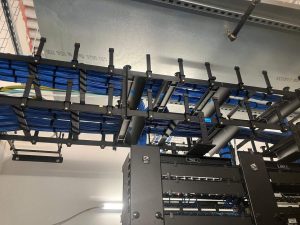
Neatly bundled cable runs drop from overhead ladder rack into labeled racks, so every connection is easy to trace, audit, and secure.
Ask most IT leaders how they secure a data center and you’ll hear about firewalls, encryption, and zero trust policies. Those matter, but every one of them rides on something physical: the copper and fiber running under raised floors and through overhead trays. Data center structured cabling is the foundation that every server, switch, camera, and badge reader depends on. When it’s disorganized, undocumented, or exposed, it quietly becomes one of the weakest points in the building. Securing the modern data center starts at the physical layer.
Why the Physical Layer Is a Security Issue
Attackers don’t always come through the internet. An unauthorized patch cord plugged into an open switch port, a tap placed on an unmonitored fiber run, or a contractor with too much access to a cabinet can bypass layers of digital defenses. Accidents count too: a technician who pulls the wrong cable in a tangled rack can take down a production system as effectively as any attacker. Data center structured cabling reduces both risks by replacing ad hoc connections with an organized, documented, and controlled system.
What Is Data Center Structured Cabling?
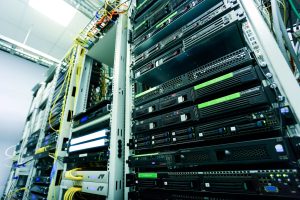
Clear labels on every server and port show the visibility that data center structured cabling provides, so teams know exactly what each device does and where it connects.
Structured cabling for data centers is a standardized approach to designing and installing the copper and fiber that connect every piece of equipment in the facility. Instead of running point-to-point cables directly between devices, a structured system uses defined zones (the entrance room, main distribution area, horizontal distribution areas, and equipment distribution areas) connected by a backbone of fiber and high-performance copper. Industry standards such as ANSI/TIA-942 guide how these spaces are laid out, how pathways are routed, and how redundancy is built in. The result is data center network infrastructure that is predictable, scalable, and far easier to secure.
How Data Center Structured Cabling Strengthens Security
Visibility through documentation. Every cable, port, and patch panel in data center structured cabling is labeled and recorded. When teams know exactly what should be connected where, an unexpected device or rogue connection stands out immediately during an audit.
Physical network segmentation. Structured cabling for data centers makes it practical to separate production traffic, management networks, out-of-band access, and building systems onto dedicated cabling and pathways. Physical separation backs up the logical segmentation your firewalls and VLANs enforce.
Controlled, lockable pathways. Well-designed data center structured cabling runs through enclosed trays, conduit, and locking cabinets rather than open ceilings or shared closets. Entrance rooms, where carrier circuits arrive, can be restricted to a short list of approved personnel.
Redundancy and resilience. Diverse cable routes, dual entrance points, and redundant backbone links mean a single cut fiber or damaged conduit doesn’t take critical systems offline. Availability is a security goal, too, and data center structured cabling is what makes that redundancy real.
Cleaner airflow and safer operations. Organized cabling keeps hot and cold aisles clear, supports stable temperatures, and reduces the risk of human error during maintenance, which remains one of the most common causes of unplanned downtime.
Layering Physical Security on Top of the Network
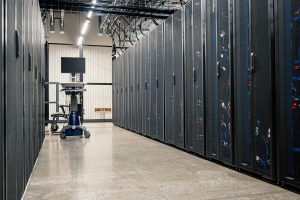
Locking cabinet doors, a caged perimeter, and overhead cable trays work together, so data center structured cabling stays out of reach of anyone without access.
Data center network infrastructure doesn’t only carry customer workloads. It also powers the physical security systems that protect the facility. Card and biometric readers at perimeter doors, mantraps at the data hall entrance, cabinet-level electronic locks, IP cameras, and environmental sensors for temperature, humidity, water, and smoke all depend on reliable cabling and Power over Ethernet.
Planning data center structured cabling alongside these systems ensures every reader, lock, and camera has a dedicated, protected connection, and that security devices stay isolated from the networks they’re protecting. When a cabinet door opens, the system should know who opened it and when, and have video to confirm it.
Common Cabling Mistakes That Create Risk
- Undocumented patch cords that nobody can trace during an incident.
- Abandoned cable left in trays after equipment moves, creating clutter and hiding unauthorized connections.
- Open, unused switch ports that let anyone with a laptop and a patch cord plug in.
- Shared pathways where security, management, and tenant cabling run together without separation.
- Unsecured overhead or under-floor access that lets someone reach cabling without passing through a controlled door.
Each of these problems is common in facilities that grew quickly without a data center structured cabling plan, and each can be fixed through a professional assessment, cleanup, and re-documentation.
What to Look for in Data Center Cabling Services
Not every installer understands the security side of the job. When evaluating data center cabling services, look for a team that:
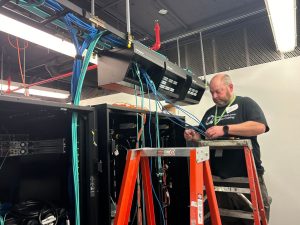
A cabling technician makes and checks each connection at overhead patch panels, so the documentation matches what’s actually installed.
- Designs to recognized standards such as ANSI/TIA-942 and documents every connection as-built.
- Tests and certifies copper and fiber links, with results you keep on file.
- Plans access control, video, and environmental monitoring together with the cabling, not as an afterthought.
- Follows your facility’s escort, access, and change-management procedures while on site.
- Offers ongoing moves, adds, and changes so documentation stays accurate long after installation.
The right partner treats data center structured cabling as part of your security program rather than a construction line item, and brings the same discipline to every future change in your data center network infrastructure.
Bringing It All Together
Securing the modern data center takes more than software. Firewalls, encryption, and monitoring tools all depend on a physical foundation that is organized, documented, and protected. Investing in data center structured cabling gives security teams the visibility to spot what doesn’t belong, the separation to contain problems, and the resilience to keep critical systems online. Start with an honest audit of your racks, pathways, and entrance rooms, then build the physical layer your digital defenses deserve.
For help with any project or installation in the New Jersey or Philadelphia area please call us at 877-832-1206.
For more ideas please visit – https://www.bridgecable.com/services/
For more information and educational content please visit:
https://www.youtube.com/@BridgeCable
Copyright © 2026 Bridge Cable. All rights reserved.
Mailing: 2745 Terwood Road, Willow Grove, PA 19090
Warehouse: 2066 W. Hunting Park Ave, STE 308, Philadelphia, PA 19140
Related Posts

How Does Cable Networking for Schools Integrate Security?
How Does Cable Networking for Schools Power AI Security?