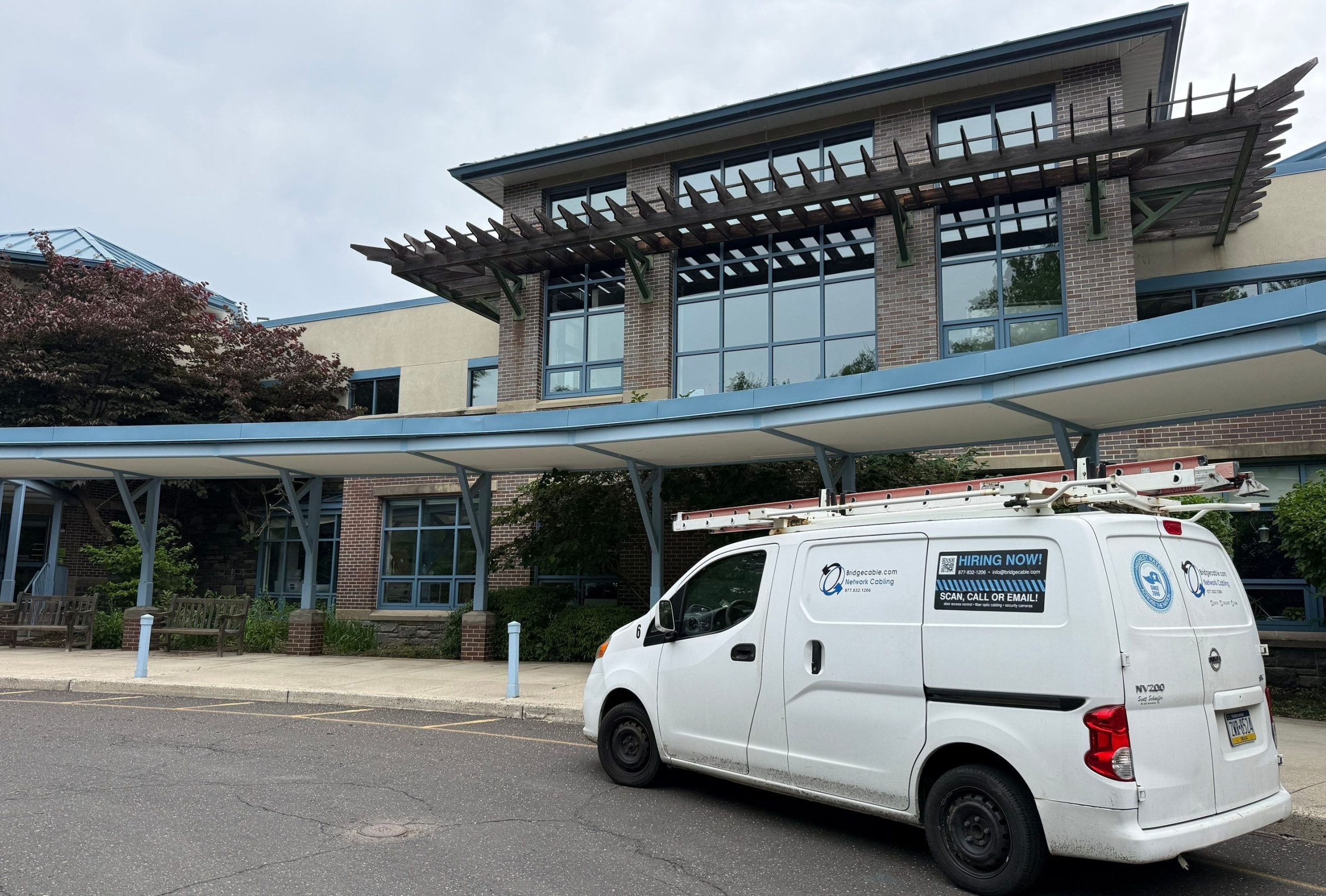
How Does Cable Networking for Schools Power AI Security?
A few years ago, a school security camera was a passive witness. It recorded, and someone reviewed the footage after something had already gone wrong. Today, AI-powered video analytics can spot a brandished weapon, a medical emergency, or a propped exterior door as it happens and push an alert to staff within seconds. The part of that story most districts overlook is the wire. Every smart camera, sensor, and alert depends on cable networking for schools that can move high-resolution video reliably, around the clock, without dropping frames at the worst possible moment.
What AI-Powered School Security Actually Does
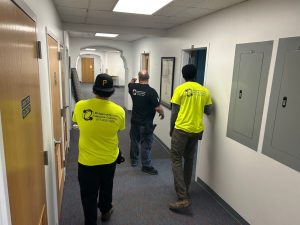
Every reliable AI security system starts with a walkthrough. Our technicians trace cable paths, check closets and panels, and map out the cable networking for schools that will carry every camera feed and alert.
AI school security layers software on top of cameras and sensors to recognize patterns a human monitor might miss across dozens of screens. Common capabilities include visible-weapon detection, fight and fall detection, perimeter and after-hours intrusion alerts, forensic video search by clothing or vehicle, and automated responses such as door lockdowns or mass notifications, all running over cable networking for schools. Uvalde CISD, for example, received a $400,000 grant to add AI gun detection that the vendor says can detect, verify, and respond to a threat within 30 seconds. Other districts, like Manassas City Public Schools in Virginia, use AI-assisted weapons screening at entrances to check thousands of students each morning, a workload that leans on cable networking for schools to keep every lane connected.
None of those outcomes happen on a weak network. Cable networking for schools is the path that carries each video stream from the camera to the analytics engine and each alert from the engine to a phone, a radio, or a door controller.
Smarter Detection Starts With the Network
AI detection is only as good as the images it analyzes. Higher-resolution cameras and higher frame rates give the model more detail to work with, which improves accuracy, but they also multiply bandwidth demand. A campus running a few hundred 4K streams needs cable networking for schools built for sustained throughput, not a patchwork of legacy Cat5e runs.
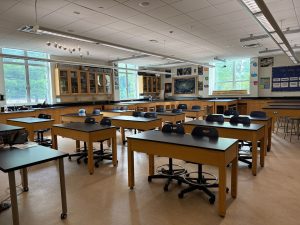
When an AI system flags a threat, the alert has to reach every classroom in seconds. Cable networking for schools connects classroom phones, ceiling speakers, and devices like these to the school’s security and notification systems.
Bandwidth and backbone. Category 6A copper to the edge and fiber between buildings and IDF closets give the school network cabling the headroom to carry continuous video without congestion.
Power over Ethernet. Most AI-capable cameras draw power through the same cable that carries data. Well-designed education facility cabling accounts for PoE budgets, cable length limits, and heat in bundled runs.
Segmentation. Cable networking for schools should keep security traffic on its own VLANs, separate from student Wi-Fi and classroom devices, so a bandwidth-hungry lesson never degrades a live camera feed.
Faster Response Depends on Low Latency
When an AI engine flags a potential threat, the clock starts. Some vendors report response times 60 to 80 percent faster than traditional monitoring, but those gains assume cable networking for schools lets the alert travel instantly to the people who act on it. A network with redundant uplinks, battery-backed switches, and properly terminated fiber keeps that chain intact during a power flicker or a single failed link. K-12 & campus network infrastructure also has to integrate with access control, intercoms, and mass notification systems, which means the cabling plan should be designed alongside the security plan, not after it.
Responsible Deployment: Keeping Humans in the Loop
Responsible AI deployment matters as much as detection speed or the cable networking for schools behind it. In October 2025, an AI gun detection system at Kenwood High School in Baltimore County flagged a student’s bag of chips as a possible firearm. The district’s safety team reviewed and canceled the alert within about two minutes, but the message still reached police, and armed officers detained the student. The district responded by promising stronger human oversight and annual protocol training. Better cameras and cable networking for schools can sharpen what reviewers see, but they can’t replace clear escalation rules. Meanwhile, the same technology did not catch a concealed gun before the January 2025 shooting at Antioch High School in Nashville, a reminder that AI only sees what the camera sees.
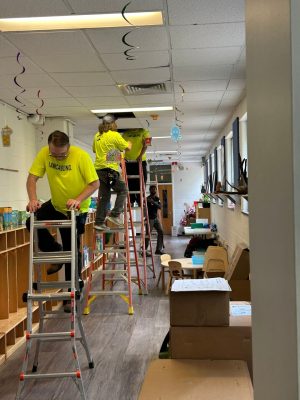
Summer break is the installation season. While classrooms sit empty, our crew opens the ceiling and runs the cable networking for schools that AI cameras, alerts, and access control need when students return.
Those incidents point to a few practical rules for any district:
- Require human verification before any alert triggers a police response.
- Treat AI as one layer, alongside access control, trained staff, and physical barriers.
- Set clear data policies on video retention, who can search footage, and how long alerts are stored.
- Audit performance regularly, including false positive rates and response times.
Solid cable networking for schools supports every one of those rules. Reliable, segmented networks deliver clear footage for human reviewers, protect sensitive video from unauthorized access, and generate the logs needed for audits.
What to Plan Before Adding AI Security
Before signing an AI security contract, walk the campus with your IT team and a cabling contractor. Document which cameras are analog, which switches lack PoE capacity, and which buildings still rely on aging copper backbones. Many AI platforms work with existing IP cameras, so upgrading school network cabling can unlock AI capabilities without replacing every device. Plan for growth, too: cable networking for schools installed today should carry the next generation of cameras and sensors without another round of ceiling work.
Bringing It All Together
AI is changing how schools detect threats and coordinate a response, but the technology is only as dependable as the infrastructure beneath it. Districts that invest in well-designed cable networking for schools, pair AI with human judgment, and set clear policies on privacy and oversight will get the benefits of smarter detection without the costly mistakes. The cameras and algorithms get the headlines. The cabling is what keeps them working when it counts.
For help with any project or installation in the New Jersey or Philadelphia area please call us at 877-832-1206.
For more ideas please visit – https://www.bridgecable.com/services/
For more information and educational content please visit:
https://www.youtube.com/@BridgeCable
Copyright © 2026 Bridge Cable. All rights reserved.
Mailing: 2745 Terwood Road, Willow Grove, PA 19090
Warehouse: 2066 W. Hunting Park Ave, STE 308, Philadelphia, PA 19140
Related Posts
How Does Cable Networking for Schools Integrate Security?
How Does Data Center Structured Cabling Improve Security?